


How to Store Cooked Boba Pearls Overnight (Without Losing the Chew)

How to Store Cooked Boba Pearls Overnight
You cooked a full batch of tapioca pearls, used what you needed for today's drinks, and now there's a bowl of leftover boba sitting on the counter. Can it make it to tomorrow? Yes — but only if it's stored the right way. Cooked boba dries out and turns hard almost as soon as it's left dry and cold, so the goal isn't just "find a container." It's keeping the pearls submerged, sealed, and cold in a way that slows down what the starch naturally wants to do overnight.
Short answer: submerge your cooked boba in simple syrup, seal it in an airtight container, and refrigerate for no more than 24 hours before reheating.
The rest of this guide covers why that works, exactly how long boba actually lasts, how to reheat pearls that have gone hard, and when freezing beats the fridge. This is the same storage logic used at Yiouyi, where we've supplied tapioca pearls to bubble tea shops and cafés for over 20 years — the method below is the same one commercial kitchens rely on, scaled down for a home batch. How to Store Cooked Boba Pearls Overnight
Table of Contents
Can You Put Cooked Boba in the Fridge?
Yes, cooked boba can go in the fridge — but plain refrigeration on its own isn't enough. Tapioca starch is what gives boba its chewy "QQ" texture, and starch molecules re-tighten as they cool, a process food scientists call retrogradation. That's the same reason day-old rice or refrigerated bread firms up. Left dry in a container, boba pearls turn into small, cold, rubbery pebbles by morning.
The fix is straightforward: don't refrigerate the pearls dry. Refrigerate them submerged in liquid — ideally simple syrup rather than plain water. Syrup slows moisture loss more effectively than water alone, which is the difference between boba that's still chewable tomorrow and boba that's turned into candy-coated gravel. How to Store Cooked Boba Pearls Overnight
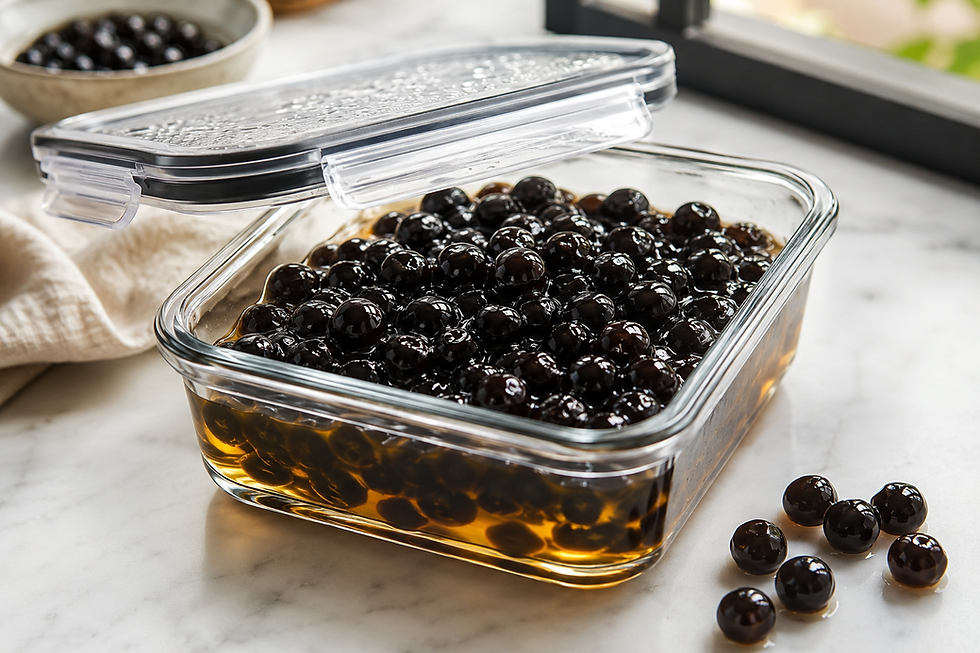
How to Keep Boba Soft Overnight: The Simple Syrup Method
This is the same technique bubble tea shops use to hold cooked pearls for service throughout the day, adapted for overnight home storage.
Quick overview:
Cook the tapioca pearls as usual.
Make a simple syrup (equal parts sugar and water, heated just until dissolved).
Drain the pearls and submerge them fully in the warm syrup.
Let them sit for several minutes so the syrup soaks in.
Transfer everything — pearls and syrup together — into an airtight container and refrigerate.
The exact ratios and step-by-step are below. How to Store Cooked Boba Pearls Overnight
Why Does Boba Get Hard in the Fridge?
Cold accelerates starch retrogradation. As tapioca pearls cool, the starch chains that loosened during boiling begin to re-align and tighten, pushing moisture out and leaving the pearls dense and chalky in the center. This happens fastest when pearls sit dry or in plain water, since there's nothing counteracting the moisture loss. Sugar syrup helps because it draws less water out of the pearls and creates a slightly viscous barrier that slows the process — it won't stop retrogradation completely, but it buys enough time to make overnight storage realistic. How to Store Cooked Boba Pearls Overnight
How Long Does Cooked Boba Last? (Quick Answer)
Room temperature, dry: about 4 hours before texture and food safety both start to decline.
Refrigerated, in syrup: roughly 24 hours for the best texture. Quality holds reasonably well up to 48 hours, but expect a noticeable drop after that.
Frozen, in an airtight container: up to 1 month, with 1–2 weeks giving the best chew after reheating.
If you're storing boba specifically to use it the next day, treat 24 hours as your practical ceiling. Pearls held longer than that are often still safe to eat if they've been refrigerated properly, but the texture that makes boba worth eating in the first place drops off fast after the first day. How to Store Cooked Boba Pearls Overnight
How to Store Boba in Simple Syrup (Step-by-Step)
Cook the pearls fully, following package instructions — typically a rolling boil followed by a covered rest off the heat.
Drain and rinse briefly under cool water to stop the cooking and rinse off surface starch.
Make the syrup: combine equal parts white sugar and water (1:1 by volume) in a small saucepan and heat gently, stirring, just until the sugar dissolves. No need to bring it to a boil.
Submerge the pearls in the warm syrup so they're fully covered — this is the step people skip most often, and it's the one that matters most for texture.
Let it soak for 10–15 minutes so the pearls absorb some syrup and firm up slightly with sweetness.
Transfer to an airtight container, pearls and syrup together, leaving minimal air space.
Refrigerate immediately and use within 24 hours. How to Store Cooked Boba Pearls Overnight
Homemade Boba Pearl Storage: A Few Extra Tips
A couple of small habits make more difference than the fridge itself when you're making boba at home rather than in a commercial kitchen:
Cool before sealing. Sealing hot pearls into a container traps condensation, which waterlogs the boba and speeds up spoilage. Give them a few minutes to come down to warm first.
Keep flavors separate. If different batches were flavored (brown sugar, matcha, fruit), store them in separate containers so flavors don't bleed into each other overnight.
Portion before storing. Cold, syrup-soaked boba is harder to divide neatly once it's firmed up, so scoop it into usable portions before it goes in the fridge.
For anyone storing boba regularly for a café or drink stand rather than a one-off batch, starting with pearls engineered to hold texture longer under refrigeration makes this whole process more forgiving. Yiouyi's tapioca pearls are formulated for foodservice use specifically because home-grade pearls tend to break down faster in storage. How to Store Cooked Boba Pearls Overnight
How to Reheat Boba From the Fridge
Refrigerated boba needs reheating before serving — cold, syrup-soaked pearls straight from the fridge are noticeably firmer than fresh ones.
Bring a small pot of water to a boil.
Add the drained, refrigerated pearls and boil for 1–2 minutes — just enough to loosen the starch again, not a full re-cook.
Drain and toss immediately in a fresh spoonful of simple syrup to restore sweetness and shine.
Serve right away while warm and soft.
How to Soften Boba in the Microwave (Quick Fix)
Short on time? Skip the stovetop:
Place the refrigerated pearls in a microwave-safe bowl with a tablespoon of water or syrup.
Microwave in 10–15 second bursts, stirring between each, until the pearls turn glossy and soft again.
Stop as soon as they're pliable — overheating in the microwave can cause pearls to split or turn mushy.
How to Make Hard Boba Soft Again (Troubleshooting)
If pearls already hardened in the fridge, they're not necessarily ruined. Heat re-loosens the starch structure that firmed up during refrigeration, so a brief reheat — boiling or microwave, above — usually brings back most of the original chew. What heat can't fully fix is pearls that have dried out completely or sat for several days; by that point the starch structure has broken down too far, and reheating only gets you partway back to fresh texture.
Can You Freeze Cooked Tapioca Pearls?
Yes, and freezing is the better option if the leftover boba won't be used within a day or two.
Let the cooked pearls cool to room temperature.
Transfer to a freezer-safe, airtight container or bag, leaving a little room for expansion.
Label with the date.
Freeze for up to 1 month — 1–2 weeks gives the best texture on reheating.
Thaw briefly, then reheat using the boiling method above. Skip the microwave straight from frozen, since it heats unevenly.
Freezing trades a little texture for a much longer window, which makes it the better call for meal-prepped batches rather than "I'll finish this tomorrow" leftovers.
Key Takeaways: How to Keep Boba Chewy Overnight
Never store cooked boba dry — always submerge it in liquid, and choose syrup over plain water.
Seal it airtight to limit moisture loss and stop it from absorbing fridge odors.
Use within 24 hours for the best texture; anything past 48 hours is a texture gamble even if it's still technically safe to eat.
Reheat briefly in hot water or short microwave bursts before serving — cold, unreheated boba is never as good.
If it won't be used within a day or two, freeze it instead of refrigerating it.
FAQ-How to Store Cooked Boba Pearls Overnight
Can you put cooked boba in the fridge? Yes, but only submerged in syrup or water and sealed in an airtight container. Dry refrigeration turns pearls hard within a few hours.
How long does cooked boba last in the fridge? About 24 hours for the best texture when stored in syrup. Some sources note pearls stay usable up to 48–72 hours, though chewiness declines steadily after the first day.
Can you freeze cooked tapioca pearls? Yes — in an airtight, freezer-safe container, cooked pearls keep for up to a month, with 1–2 weeks being ideal for texture.
Is it better to store boba in syrup or water? Syrup. It slows moisture loss more effectively than plain water and keeps the pearls flavorful as well as chewy.
Wrapping Up-How to Store Cooked Boba Pearls Overnight
Storing cooked tapioca pearls overnight comes down to one principle: keep them submerged, sealed, and cold, and always reheat before serving. The simple syrup method is the closest thing to a guarantee that tomorrow's boba will still taste like boba — not a bowl of cold starch pellets.
If you're running a café or beverage business rather than a home kitchen, sourcing tapioca pearls built to hold their texture under commercial storage conditions removes a lot of this guesswork. You can browse Yiouyi's wholesale tapioca pearls or read more prep and storage guides on the Yiouyi blog. For bulk pricing or samples, get in touch with our team — and learn more about our 20+ years sourcing directly from Taiwan on our About page.


Comments