


How to Cook Boba: Easy Guide to Perfect Tapioca Pearls

How to Cook Boba: Easy Guide to Perfect Tapioca Pearls
How to cook boba is one of the most common questions for anyone making bubble tea at home. The good news is that cooking tapioca pearls is straightforward once you understand the basic process.
The key is to use plenty of boiling water, add the pearls at the correct stage, cook them according to the package instructions, allow them to rest when required, and finish them with a sweet syrup.
However, there is no single cooking time that works for every type of boba. Traditional dried tapioca pearls, mini pearls, and quick-cooking pearls can have very different preparation requirements. Several established recipe sources emphasize checking the package because pearl size and formulation affect cooking time.
This guide explains how to cook boba at home, how to tell when tapioca pearls are done, how to sweeten them, and how to avoid common mistakes.
What Is Boba?
Boba is commonly used to describe the chewy tapioca pearls served in bubble tea. Traditional tapioca pearls are made primarily from tapioca starch derived from cassava.
When properly cooked, the pearls should have a soft exterior with a pleasantly chewy center rather than being hard, chalky, or mushy.
Tapioca pearls are one of the most recognizable ingredients in bubble tea, but they can also be used in desserts and other sweet foods.
What You Need to Cook Boba
For a basic batch of dried tapioca pearls, you generally need:
Plenty of water
A large pot
A spoon or utensil for stirring
A strainer
Brown sugar, white sugar, honey, or prepared syrup
The exact quantities should depend on the package directions for your particular pearls.
A generous amount of water is important because tapioca pearls release starch while cooking and can stick together if there is not enough water. Different recipes recommend ratios ranging from around 5 parts water to 1 part pearls to considerably more, so the product instructions should take priority.
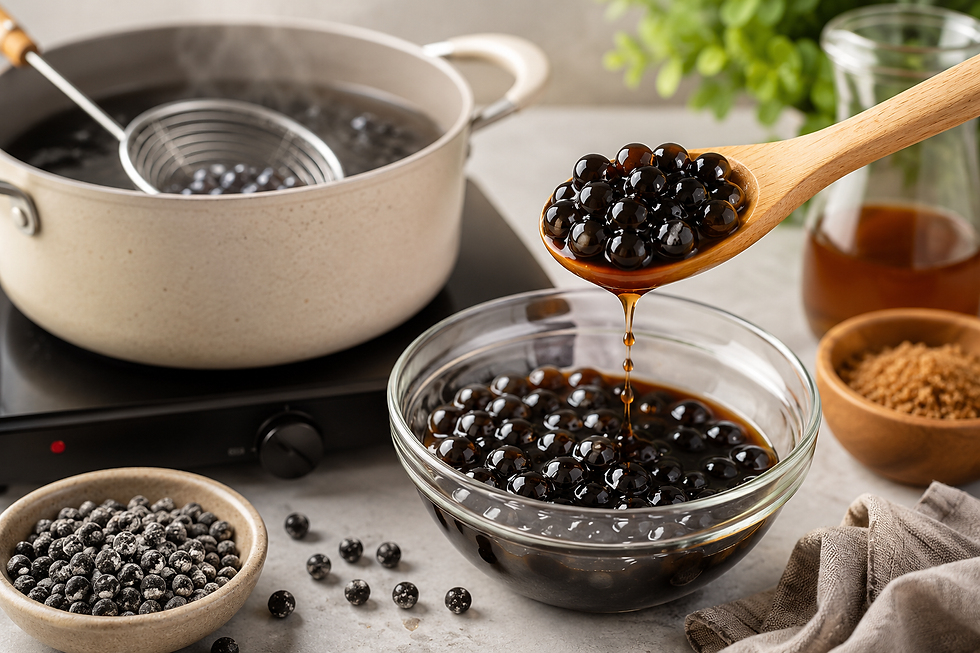
How to Cook Boba Step by Step
Step 1: Check the Package Instructions
Before putting your tapioca pearls into the pot, check the package.
This is especially important because not all boba cooks the same way.
Some dried pearls may require a longer cooking and resting period, while quick-cooking varieties can be ready in only a few minutes. Hungry Huy, for example, specifically separates standard pearls from quick-cooking products and recommends following the package instructions when available.
If the package provides cooking instructions, use those as your primary guide.
Step 2: Bring Plenty of Water to a Full Boil
Fill a large pot with enough water to allow the pearls to move freely.
Bring the water to a strong, rolling boil before adding the tapioca pearls.
Starting with boiling water helps the pearls cook more evenly and reduces the risk of sticking.
Food Network's tapioca pearl method also begins by adding the pearls to boiling water and emphasizes maintaining a simmer during cooking.
Step 3: Add the Tapioca Pearls
Carefully add the dried tapioca pearls to the boiling water.
Stir them gently after adding them so that they do not settle and stick to the bottom or clump together.
Avoid adding the pearls before the water reaches a proper boil unless your specific product instructions say otherwise.
Step 4: Cook According to the Pearl Type
This is where many homemade boba recipes go wrong.
There is no universal cooking time for every tapioca pearl.
For example, The Woks of Life describes a method involving 15 minutes of cooking followed by 15 minutes of covered resting for a particular type of dried pearl.
Hungry Huy describes a 30-minute cooking period followed by a 30-minute rest for many standard pearls, while separately noting that certain quick-cooking brands require only a few minutes.
Food Network similarly explains that cooking time depends on pearl size and reports that larger pearls may require substantially longer cooking.
The practical rule is simple: follow the package directions first.
Step 5: Stir During Cooking
Stir the pearls periodically.
This helps prevent them from sticking to the bottom of the pot or sticking to each other.
You do not need to stir constantly, but checking them periodically is useful, particularly during longer cooking periods.
If the pearls are sticking heavily, make sure you are using enough water and maintaining the cooking temperature recommended by the package.
Step 6: Let the Boba Rest if Required
Some types of tapioca pearls need a covered resting period after cooking.
During this stage, the remaining heat helps the center of the pearls finish hydrating.
For example, The Woks of Life uses a covered resting period after cooking, while other methods use different cooking and resting times.
Again, the correct resting period depends on the product.
Step 7: Check the Texture
Texture is one of the best ways to determine whether your boba is ready.
A properly cooked tapioca pearl should generally be:
Soft on the outside
Chewy in the center
Cooked through without a hard, dry core
Food Network recommends looking for pearls that are translucent and slightly chewy rather than mushy.
If you cut or bite into a pearl and find a hard, chalky center, it likely needs additional cooking or resting.
If the pearls have become extremely soft and are losing their shape, they may have been overcooked.
Step 8: Drain the Pearls
Once the tapioca pearls have reached the desired texture, drain them using a strainer.
Remove the excess cooking water.
Depending on the recipe and product instructions, rinse the cooked pearls with cool or cold water to remove excess surface starch and help improve their texture. Several established methods recommend rinsing after cooking.
Step 9: Sweeten the Boba
Cooked tapioca pearls can be placed in a sweet syrup after draining.
Common choices include:
White sugar syrup
Honey
Other prepared sweeteners
The syrup adds sweetness and helps keep the pearls from sticking together.
For example, The Woks of Life recommends placing cooked tapioca pearls into sugar water, while Food Network describes using warm sugar water after cooking.
Allow the pearls to absorb the syrup for the period recommended by your recipe.
Step 10: Add the Boba to Your Drink
Your cooked boba is now ready to use.
Add the tapioca pearls to the bottom of a glass and pour in your prepared bubble tea.
Classic combinations include:
Black milk tea with boba
Green tea with milk
Oolong milk tea
Brown sugar milk tea
Fruit tea with tapioca pearls
Matcha milk tea
Add ice if desired and serve with a wide bubble-tea straw.
How Long Does It Take to Cook Boba?
There is no single correct answer.
Cooking time depends on the type, size, brand, and formulation of the tapioca pearls.
Some standard dried pearls can require 15–30 minutes or longer, followed by a covered resting period. Certain quick-cooking pearls may be ready in approximately five minutes.
For example, China Sichuan Food gives different instructions for standard and quick-cooking pearls, while Hungry Huy specifically notes that quick-cooking brands can have much shorter cooking times.
Therefore, do not automatically cook every package of boba for 30 minutes.
Read the package first.
How Do You Know When Boba Is Cooked?
The best indicator is texture.
Properly cooked tapioca pearls should generally be chewy rather than hard or mushy.
A pearl that is still hard or opaque in the center may need more cooking.
A finished pearl should typically have a translucent appearance, although the exact appearance can vary by product and color. Food Network recommends checking for a slightly chewy texture and avoiding a mushy result.
When trying a pearl for doneness, allow it to cool enough to taste safely.
Why Is My Boba Hard in the Middle?
If your boba is hard in the center, it may not have been cooked long enough.
Possible reasons include:
The cooking time was too short.
The pearls were added before the water reached a full boil.
The pearls are larger than expected.
The package requires a resting period.
The product requires a different cooking method.
Do not automatically assume that adding more heat for a few minutes is the solution.
Check the package directions first.
Some cooking methods rely on both boiling and resting to allow the pearls to hydrate completely.
Why Does Boba Get Mushy?
Boba can become mushy when it is overcooked or held in liquid for too long.
Tapioca pearls have a limited ideal texture after cooking. They are best enjoyed relatively soon after preparation.
The Woks of Life notes that cooked pearls lose their chewiness relatively quickly, while Food Network recommends serving cooked tapioca pearls immediately or within a short period.
For the best texture, prepare only the amount you expect to use.
Should You Rinse Boba After Cooking?
Many recipes recommend rinsing cooked tapioca pearls after draining.
The purpose is to remove excess surface starch and cool the pearls.
However, there is an important distinction: some sources advise against rinsing before cooking because dry pearls can be delicate, while rinsing after cooking is commonly included in preparation methods.
Therefore:
Do not rinse dry boba unless the package specifically instructs you to.
After cooking, follow the product or recipe instructions regarding rinsing.
How to Make Brown Sugar Boba
Brown sugar is one of the most popular ways to sweeten cooked tapioca pearls.
After the pearls are fully cooked and drained, place them in brown sugar syrup.
A simple syrup can be made by dissolving brown sugar in hot water.
You can then allow the cooked pearls to sit in the syrup so they absorb some of the sweetness.
Some recipes use brown sugar directly with the cooked pearls, while others prepare a separate syrup.
For a homemade brown sugar milk tea, place the sweetened boba in a glass, add milk tea, and serve over ice.
Can You Cook Boba in a Rice Cooker?
Some commercial bubble-tea operations use rice cookers or specialized equipment to prepare larger batches of tapioca pearls.
However, for home preparation, a large saucepan or pot is usually sufficient.
The cooking method should still follow the specific product instructions.
For commercial applications, equipment capacity, temperature control, batch size, and holding procedures need to be considered separately from a small home batch.
Can You Cook Boba in the Microwave?
Microwave instructions vary considerably by product.
Some packaged products may specifically be designed for microwave preparation, while traditional dried tapioca pearls generally have stovetop instructions.
Do not assume that a microwave method is suitable for every type of boba.
If the packaging does not provide microwave directions, use the recommended stovetop method instead.
How to Store Cooked Boba
Freshly cooked tapioca pearls have a relatively short ideal serving window.
They gradually lose their characteristic chewy texture during storage.
For the best quality, prepare the amount you expect to use and serve the pearls relatively soon after cooking.
Different manufacturers and recipes may provide different holding recommendations, so follow the instructions associated with your particular product.
Do not assume that cooked boba will maintain its original texture indefinitely in the refrigerator.
Common Mistakes When Cooking Boba
Using Too Little Water
Tapioca pearls release starch during cooking.
Using a generous amount of water gives them room to move and can help reduce sticking.
Adding Boba Before the Water Boils
Many cooking methods call for adding pearls only after the water reaches a rolling boil.
Starting too early can affect cooking consistency.
Ignoring the Package Instructions
This is probably the most important mistake.
Different boba products can have dramatically different cooking requirements.
A quick-cooking pearl should not necessarily be treated like a traditional dried pearl.
Cooking Only by the Clock
A timer is useful, but it is not the only indicator.
Check the actual texture of the pearls.
Overcooking the Pearls
Cooking for longer than necessary can turn chewy pearls into soft or mushy ones.
Leaving Cooked Boba in Water Too Long
The texture can deteriorate if cooked pearls remain in liquid for an extended period.
How to Cook Quick-Cooking Boba
Quick-cooking boba is designed to reduce preparation time.
However, "quick cooking" does not mean every quick-cooking pearl uses the same method.
Some products may require only several minutes of cooking and a short resting period.
For example, Hungry Huy describes quick-cooking instructions for specific brands that involve only a few minutes of cooking. China Sichuan Food also provides a separate five-minute method for quick-cooking pearls.
Always check the label before cooking quick boba.
The product's instructions are more reliable than applying a generic cooking time.
How to Cook White Tapioca Pearls
White tapioca pearls can require different cooking times from dark or black pearls depending on their size and formulation.
Some white pearls are traditional dried tapioca pearls, while others may be quick-cooking products.
The Woks of Life specifically notes that white dried tapioca pearls can require longer cooking and that their method should not be confused with quick-cooking varieties.
Follow the package directions and judge doneness by texture.
How to Cook Boba for Bubble Tea
If your goal is to make restaurant-style bubble tea at home, the basic sequence is:
Cook the pearls → drain → rinse if instructed → sweeten → prepare the tea → add milk or other ingredients → add ice → combine and serve.
The pearls should be prepared close to the time you plan to drink the bubble tea because their texture changes relatively quickly after cooking.
Easy Homemade Boba Tea Recipe
Once your tapioca pearls are ready, making a simple bubble tea is easy.
Ingredients
You can use:
Cooked tapioca pearls
Milk
Sugar or syrup
Ice
Method
First, prepare your black tea and allow it to cool.
Place the cooked and sweetened tapioca pearls in a large glass.
Add ice if desired.
Pour the cooled tea over the pearls.
Add milk and sweetener according to your preferred taste.
Stir well and serve with a wide straw.
You can change the tea base, sweetness, milk, and toppings to create different bubble tea combinations.
Can You Make Boba From Scratch?
Yes, tapioca pearls can also be made from tapioca starch rather than purchased dried.
However, homemade pearls require additional preparation because the dough needs to be formed and shaped into small balls before cooking.
For most people making bubble tea at home, purchasing dried tapioca pearls is significantly simpler.
Commercially produced pearls also provide more consistent size and cooking behavior.
Food Network notes that tapioca pearls are widely available through Asian grocery stores, making purchased pearls a practical option for homemade bubble tea.
Choosing Good Tapioca Pearls
When buying boba, consider:
Cooking Time
Choose traditional pearls if you want a more traditional preparation process, or quick-cooking pearls if convenience is your priority.
Pearl Size
Different sizes produce different textures and can require different cooking times.
Ingredients
Check the ingredient list, especially if you have dietary restrictions or allergies.
Package Directions
Clear cooking instructions are valuable because different products can behave differently during cooking.
Intended Use
Some pearls are specifically designed for bubble tea, while others may be intended for desserts or other applications.
YIOUYI Tapioca Pearls for Bubble Tea
For cafés, restaurants, distributors, and beverage businesses, consistent tapioca pearls are important because cooking consistency directly affects the final drink experience.
YIOUYI supplies bubble tea ingredients for commercial beverage applications, including tapioca pearls, tea, popping boba, syrups, powders, jellies, and other toppings.
When preparing commercial batches, businesses should follow the specific cooking instructions supplied with their chosen product rather than relying on a generic internet recipe.
This is particularly important when changing pearl size, formulation, or supplier because cooking time and handling requirements can change.
For businesses developing a bubble tea menu, combining properly cooked tapioca pearls with quality tea and beverage ingredients can help create a consistent product across different servings.
Frequently Asked Questions
How do you cook boba?
Bring plenty of water to a rolling boil, add the dried tapioca pearls, stir gently, and cook according to the package directions. Some varieties require a covered resting period after cooking. Drain and rinse if instructed, then place the cooked pearls in sweet syrup.
How long should you cook boba?
Cooking time depends on the type and brand. Some traditional pearls can require 15–30 minutes or longer, while quick-cooking pearls may take only several minutes. Always check the package instructions first.
How do you know when boba is done?
Properly cooked boba should generally be soft and chewy rather than hard or mushy. Many tapioca pearls become translucent when cooked. Check the center and texture rather than relying only on a timer.
Why is my boba hard?
Hard centers usually indicate that the pearls need additional cooking or resting, although the correct solution depends on the product. Check the package instructions before extending the cooking time.
Why is my boba mushy?
Boba can become mushy from overcooking or excessive holding in liquid. Prepare the pearls according to the package directions and use them relatively soon after cooking.
Should you rinse boba after cooking?
Many cooking methods recommend rinsing cooked pearls after draining to remove excess surface starch and cool them. Follow the instructions for your specific product.
Do you rinse boba before cooking?
Generally, do not rinse dried tapioca pearls before cooking unless the product instructions specifically tell you to. Some cooking guides warn that rinsing dry pearls can affect their structure.
Can you cook boba ahead of time?
You can prepare boba ahead of serving, but cooked tapioca pearls have a limited ideal texture. They are generally best used soon after cooking because they gradually lose their chewiness.
Can you use brown sugar to sweeten boba?
Yes. Brown sugar syrup is a popular way to sweeten cooked tapioca pearls. You can prepare a simple syrup using brown sugar and water.
Is boba the same as tapioca pearls?
In bubble tea terminology, boba commonly refers to traditional chewy tapioca pearls. However, "boba" can also refer to the entire bubble tea beverage depending on context.
Final Thoughts on How to Cook Boba
Learning how to cook boba is mainly about controlling time, temperature, water, and texture.
The most important rule is that there is no universal cooking time for every tapioca pearl. Traditional dried pearls, mini pearls, and quick-cooking varieties can require different methods.
For the best results:
Use plenty of water.
Start with boiling water.
Stir gently to prevent sticking.
Follow the package cooking instructions.
Check the texture before draining.
Sweeten the cooked pearls with syrup if desired.
Serve them relatively soon for the best chew.
Once your tapioca pearls are properly cooked, you can use them in classic milk tea, fruit tea, brown sugar drinks, matcha beverages, or other homemade bubble tea recipes.
For commercial beverage businesses, selecting consistent tapioca pearls and following the manufacturer's preparation instructions is especially important for maintaining reliable texture and quality from batch to batch.


Comments