


Bubble Tea Equipment Wholesale: The Complete Sealer, Shaker & Dispenser Buying Guide for Cafés (2026)
- Feroz Ali
- 8 hours ago
- 11 min read

A complete bubble tea shop equipment list includes seven core machines: a cup sealing machine, a shaker/mixer machine, fructose/syrup dispensers, an ice machine, a commercial blender, a tea brewer, and a tapioca pearl cooker. Budget $5,000-$20,000+ total depending on shop size, and buy from wholesale bubble tea equipment suppliers who stock parts and film compatible with US cup sizes.
That's the one-paragraph version. If you're actually opening a shop, or replacing equipment that's been limping along since your first year, the real decisions live in the details — throughput numbers, film compatibility, and which corners are safe to cut versus which ones will cost you a burst cup on a Saturday rush. We've sourced equipment for cafés and distributors long enough to know where the cheap version works fine and where it doesn't.
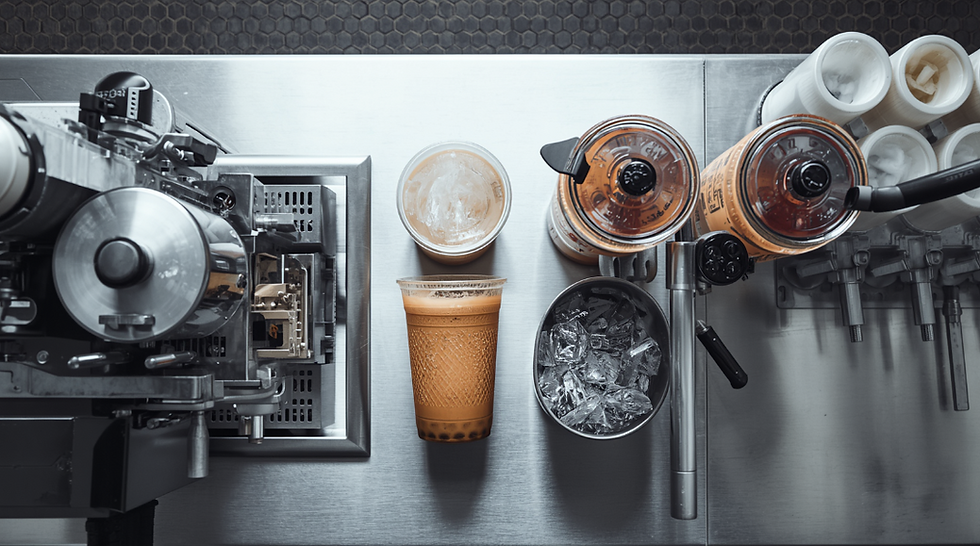
Cup Sealing Machines
The sealer is the machine people underestimate until it breaks during a rush. It's also the piece of equipment where "cheap" and "wrong size" cause the most return shipments, because sealing film isn't universal — cup diameter, film roll width, and machine die size all have to match.
Manual sealers are foot-pedal or lever-operated. An operator sets the cup on the sealer plate and manually engages the seal for each drink. They're slow relative to automatic units but require almost no maintenance and tolerate power fluctuations better, which matters for shops in older buildings with inconsistent circuits.
Automatic (electric) sealers detect the cup, feed film automatically, heat-seal, and cut in one motion. Some models include a lifting or turntable mechanism so a single operator can seal one cup while loading the next.
Throughput: Manual sealers run roughly 60-120 cups/hour depending on operator speed. Automatic sealers run 300-500+ cups/hour, with high-speed commercial units rated up to 700-800 cups/hour.
Wattage: Manual units draw minimal power (small heating element only, often under 300W). Automatic sealers typically pull 600-1,200W depending on heating element size and cycle speed.
Film compatibility: This is the detail that trips up first-time buyers. Confirm your sealer's die size matches standard US cup diameters (90mm and 95mm are the most common) and that it accepts both PET and PP sealing film — some machines are locked to a single film width or material by their manufacturer.
Price range (estimate): Manual sealers run $150-$500. Automatic sealers range $800-$2,500 for standard commercial units, with high-speed or dual-head models reaching $3,000-$5,000. These are wholesale-tier estimates, not quotes — always confirm current pricing with your supplier.
Best suited for: Manual sealers fit startups, kiosks, and shops doing under 150 drinks/day. Automatic sealers become worth the investment once you're consistently clearing 200+ drinks/day, since the labor time saved pays back the price difference within a few months.
Shaker/Mixer Machines-Bubble Tea Equipment Wholesale
Every bubble tea drink gets shaken — ice, tea, milk, and syrup need to combine evenly, and doing that by hand all day is a repetitive-strain injury waiting to happen. An automatic shaker machine solves this with programmable cycles that mimic the wrist-shake motion at a consistent speed and duration. Established shaker brands in the boba equipment space (Dasin is one commonly cited example) are worth researching directly on spec sheets and current pricing, since model lineups and availability change often.
Throughput: Single-cup shakers handle one drink per 15-20 second cycle, roughly 180-240 cups/hour if run back to back. Dual-cup and multi-arm commercial shakers can hit 400-600 cups/hour.
Wattage: Single-arm units typically draw 150-300W. Multi-arm commercial machines with programmable cycle settings draw 400-750W.
Compatibility: Check the cup-holder clamp size against your actual cup supplier — some shakers are built for a narrower range of cup diameters and won't securely hold oversized 24oz cups, which is a real problem if you carry large-format drinks on your menu.
Price range (estimate): Single-arm manual-load shakers run $300-$900. Programmable multi-arm commercial shakers range $1,200-$3,500.
Best suited for: A single-arm shaker is fine for a startup or a shop still testing its menu. Anything doing sustained lines — think a shop doing 300+ drinks a day during a weekend rush — needs a multi-arm unit, or your barista becomes the bottleneck instead of the sealer.
Fructose/Syrup Dispensers
A fructose dispenser (also sold as a syrup pump or liquid dispenser) controls pour volume for sweetener, which matters more than it sounds like. Manual pour-and-eyeball sweetening leads to inconsistent drinks, and inconsistent drinks are the fastest way to lose repeat customers who noticed their usual order tasted different.
Throughput: Manual pump dispensers are limited by operator speed, roughly 100-150 pours/hour per station. Automatic metered dispensers can service 300+ pours/hour and often run multiple flavor lines from one unit.
Wattage: Manual pump dispensers require no power. Automatic/metered dispensers draw 20-60W — low power draw, but they do need a stable electrical connection near your prep station, which is worth planning for during buildout.
Compatibility: Confirm the pump gasket material is rated for high-fructose syrup and citrus-based syrups specifically — cheaper gaskets degrade faster with acidic syrups and start leaking within months.
Price range (estimate): Manual pump dispensers run $40-$150 per unit. Automatic metered dispensers range $200-$600 per station, or $800-$2,000 for multi-flavor tower systems.
Best suited for: Manual pumps are fine at any volume if consistency isn't a major issue for your menu. Automatic dispensers make sense once you're running 8+ syrup flavors and want pour consistency without training every new hire on manual technique.
Ice Machines
Ice is the highest-volume input in a bubble tea shop by weight, and it's the equipment category most likely to get under-bought because owners size it off their opening-week volume instead of their busy-season volume.
Throughput: Undercounter ice machines produce roughly 50-100 lbs/day. Mid-size commercial units produce 200-350 lbs/day. High-volume modular ice machines produce 400-800+ lbs/day.
Wattage: Undercounter units draw 300-500W. Mid-size commercial machines draw 600-1,000W. High-output modular units can draw 1,200-2,000W and typically need a dedicated circuit.
Compatibility: Bubble tea shops generally want nugget or small-cube ice, since it packs into a shaker cup and blends into the drink texture better than standard cube ice. Not every commercial ice machine offers a nugget setting, so this is worth confirming before you order.
Price range (estimate): Undercounter units run $1,200-$2,500. Mid-size commercial machines range $2,500-$5,500. High-volume modular systems run $6,000-$12,000+ including the storage bin.
Best suited for: Undercounter machines suit kiosks and low-volume startups. Mid-size units fit most single-location cafés. High-volume modular systems are for shops doing 400+ drinks/day or multi-location operations sharing a central ice supply.
Commercial Blenders
Blenders handle slushes, fruit smoothies, and frozen specialty drinks — a menu category most boba shops carry alongside classic milk tea. This is one spot where buying underpowered equipment shows up immediately in drink quality: weak motors leave ice chunks instead of a smooth slush, and repeated ice-crushing burns out consumer-grade blenders within months.
Throughput: A single commercial blender can process roughly 60-100 blended drinks/hour, depending on cycle time and cooldown needs between batches. High-volume shops typically run two blenders in parallel during peak hours rather than relying on one unit alone.
Wattage: Commercial blenders built for daily ice-crushing typically draw 1,000-1,800W, noticeably more than countertop consumer blenders, which is part of why they hold up to repeated use.
Compatibility: Look for a container and blade assembly rated specifically for continuous ice crushing, not just fruit and liquid blending — this is the main spec that separates true commercial units from prosumer models. Recognizable commercial blender brands like Vitamix and Blendtec are common quality benchmarks in foodservice, though model availability and pricing should always be confirmed directly with the manufacturer or your supplier.
Price range (estimate): Commercial-grade blenders suited to daily bubble tea use run $400-$1,200 per unit, with heavy-duty models built for high-volume ice crushing reaching $1,200-$2,000.
Best suited for: A single blender covers a startup's slush and smoothie menu. Shops doing significant blended-drink volume, especially in summer months, should plan for two units so one isn't cooling down while a line waits.
Commercial Tea Brewers
The tea base is the foundation of every drink on the menu, and brewing it by the pot in a home-style kettle doesn't scale past a handful of orders a day. A commercial tea brewer batch-brews concentrated tea at consistent strength and temperature, which matters for flavor consistency as much as for speed.
Throughput: Batch brewers typically produce 3-5 gallons per brew cycle, with cycle times of 10-20 minutes depending on tea type and steep settings. A single brewer can usually support a shop doing up to a few hundred drinks a day if brew cycles are timed to stay ahead of demand.
Wattage: Commercial tea brewers generally draw 1,500-3,000W, since they're heating water to near-boiling for each batch — this is one of the higher power draws on this list and worth checking against your electrical capacity.
Compatibility: Confirm the brewer accommodates the tea format you actually use — loose leaf, tea bags, or both — and check the batch tank material (stainless steel is standard for commercial units and holds up better to daily use than plastic components).
Price range (estimate): Single-batch commercial tea brewers run $300-$900. Higher-capacity or dual-tank units used by higher-volume shops range $900-$2,000.
Best suited for: A single-tank brewer fits most startup and mid-size cafés. Shops running a large tea menu with multiple base flavors brewing simultaneously should consider a dual-tank or multi-brewer setup to avoid bottlenecking at the source of every drink.
Automatic Tapioca Pearl Cookers
Cooking tapioca pearls by hand on a stovetop is workable at very low volume, but it ties up a burner and a staff member's attention for 20-30 minutes per batch. An automatic pearl cooker manages boil time, cook time, and resting cycles with programmed settings, freeing up labor and producing more consistent texture batch to batch.
Throughput: A single automatic cooker typically handles one batch per cycle, with cycles running 30-45 minutes including boil and rest time — output per batch varies by cooker size but commonly supports 100-200 servings of pearls.
Wattage: Automatic pearl cookers generally draw 1,200-2,500W, since they need to maintain a rolling boil for an extended cycle.
Compatibility: Check the cooker's capacity against your daily pearl volume needs, and confirm whether it's designed for tapioca specifically versus a general-purpose boiling appliance — dedicated pearl cookers usually include preset programs tuned for tapioca's cook/rest cycle.
Price range (estimate): Automatic tapioca pearl cookers run $300-$900 for standard single-batch units, with larger-capacity or multi-basket models reaching $900-$1,800.
Best suited for: Any shop serving classic pearl milk tea benefits from an automatic cooker once daily pearl demand exceeds what one stovetop batch can supply — for most shops, that's earlier than they expect, especially once pearls show up in multiple menu items.
Manual vs. Automatic: Quick Comparison
Since throughput is the single biggest factor in which equipment tier you need, here's how manual and automatic equipment stack up side by side across the categories that matter most.
Equipment | Manual/Entry Tier | Automatic/Commercial Tier |
Cup sealing machine | $150-$500, 60-120 cups/hr, foot pedal or lever operated | $800-$2,500 (up to $5,000 high-speed), 300-800 cups/hr, auto-feed and cut |
Shaker/mixer | $300-$900, single-arm, ~180-240 cups/hr | $1,200-$3,500, multi-arm programmable, 400-600 cups/hr |
Fructose dispenser | $40-$150/unit, manual pump | $200-$2,000, metered/multi-flavor tower |
Ice machine | $1,200-$2,500, 50-100 lbs/day | $2,500-$12,000+, 200-800+ lbs/day |
Blender | $400-$1,200, single unit | $1,200-$2,000, heavy-duty ice-crushing rated |
Tea brewer | $300-$900, single-tank | $900-$2,000, dual-tank/high-capacity |
Pearl cooker | $300-$900, single-batch | $900-$1,800, multi-basket/high-capacity |
For a startup café doing under 150 drinks a day, entry-tier equipment across the board keeps upfront costs manageable — figure $2,700-$6,500 total across all seven categories. A high-volume shop clearing 300+ drinks a day should budget $8,500-$20,000+, since the labor savings and reliability of commercial-tier equipment pay for themselves within the first year of steady volume.
Choosing a Wholesale Supplier
The equipment spec sheet only tells half the story. Where and how you buy matters just as much, especially for a US-based café working with a manufacturer overseas.
Look for suppliers who stock compatible film and parts, not just machines. A sealer is only useful if you can keep buying film for it. Ask what sealing film widths, materials, and roll counts the supplier carries before you commit to a machine — some wholesale bubble tea equipment suppliers sell the hardware but not the consumables, which leaves you sourcing film separately from a different vendor at a markup.
Confirm voltage and certification for the US market up front. Equipment manufactured primarily for other markets sometimes ships at 220V configurations or without UL/ETL certification, which can be a problem for US commercial kitchen inspections and insurance. Ask directly, in writing, before you order — not after the machine arrives. For background on what these certification marks actually cover, UL Solutions' commercial appliance certification page is a useful independent reference.
Ask about MOQ flexibility for a first order. A supplier that requires a container-size minimum on your first equipment order isn't built for a single café opening one location. Look for suppliers with sample or small-batch options so you can test a sealer or shaker on your actual menu before committing to a larger order.
Ask what happens when something breaks. This is the question most first-time buyers skip. Find out whether the supplier offers replacement parts shipped to the US, whether there's a US-based or US-friendly support contact, and what the typical turnaround time looks like for a part replacement versus a full unit replacement — a question that comes down to how well the supplier's broader supply chain is set up to serve US buyers.
Red Flags and Mistakes to Avoid
A few patterns show up repeatedly when cafés end up unhappy with a wholesale equipment purchase:
Buying a sealer before confirming film availability. The machine is cheap; getting stuck sourcing film for a discontinued or uncommon die size is the expensive part.
No documentation on voltage or certification. If a supplier can't answer a direct question about UL/ETL listing or voltage configuration, treat that as a warning sign, not a detail to sort out later.
Ignoring wattage against your existing electrical setup. A high-output ice machine, tea brewer, or automatic sealer pulling 1,000W+ on a shared circuit with your POS system and lighting is how you trip breakers during your Saturday rush.
No local or accessible service support. If nobody can walk you through a repair or ship a replacement part within a reasonable window, a single equipment failure can shut down service for days.
Choosing equipment based on lowest price alone. The gap between a $150 manual sealer and a $2,000 automatic one is real, but so is the gap in daily capacity — buying under-capacity equipment to save money upfront often costs more in labor and lost sales within the first quarter.
FAQ for Bubble Tea Equipment Wholesale
What equipment do I need to open a bubble tea shop?
At minimum, you need a cup sealing machine, a shaker or mixer machine, syrup/fructose dispensers, an ice machine, a commercial blender, a tea brewer, and a tapioca pearl cooker if pearls are on your menu. Most startups also add a POS system, refrigeration for milk and toppings, and prep-station tools like scoops and strainers, but those seven machines make up the core boba shop equipment list.
How much does a bubble tea sealer machine cost?
Manual sealers typically run $150-$500, while automatic sealers range from $800-$2,500 for standard commercial units, up to $3,000-$5,000 for high-speed models. These are wholesale-tier estimates — actual pricing varies by supplier, film compatibility, and order volume, so treat this as a planning range rather than a quote.
What's the best sealer machine for a high-volume boba shop?
A shop consistently doing 300+ drinks a day needs an automatic sealer rated for at least 400-500 cups/hour, ideally with a dual-head or high-speed configuration. Manual sealers become a bottleneck well before that volume, since even a fast operator tops out around 100-120 cups/hour.
Do I need a 220V outlet for commercial boba equipment?
Some commercial bubble tea machines, particularly higher-output ice machines and tea brewers, are built for 220V circuits rather than standard 120V household outlets. Check the voltage spec on each machine before buildout, since retrofitting a commercial kitchen for a 220V line after equipment arrives adds unplanned electrical work and cost.
What's the difference between PET and PP sealing film?
PET film is more rigid and commonly used for cold drinks, offering a clean seal and good clarity so customers can see the drink through the top. PP (polypropylene) film is more flexible and holds up better under higher temperatures, making it a common choice for hot drink service. Confirm which one your sealer and cup supplier support, since not every machine handles both materials equally well.
Is it cheaper to buy bubble tea equipment wholesale or retail?
Wholesale pricing is almost always lower per unit, especially once you're buying multiple pieces of equipment or planning for a second location, but wholesale suppliers may have minimum order requirements. Ask about sample or small-batch options if you're a single café testing equipment for the first time.
How much does it cost to fully equip a bubble tea shop?
A startup café can equip its core stations across all seven equipment categories for roughly $2,700-$6,500 using entry-tier equipment. A high-volume shop outfitting with commercial-grade equipment across the board should budget $8,500-$20,000 or more, depending on ice machine capacity, blender count, and how many syrup lines it runs.


Comments